Formic — Compact models for an accessible, sovereign AI · Ulycorp
Skip to content
AI model developed by Ulycorp V1 coming soon on Hugging Face

Formic

Compact models for an accessible, sovereign AI.

Formic is Ulycorp's AI model program. The goal is to bring quality, speed and cost control together, so that AI is usable by businesses and individuals alike.

Formic V1 is built on Qwen 3.8 27B, with our own quantization recipe and our own inference engine. It is the technical foundation for the next generations of Formic.

Dig in ↓
Layer 01Formic V1 · Results

27 billion parameters, carried in under 10 GB.

Ants carry loads many times their own weight. Formic V1 carries Qwen 3.8 27B in 9.97 GB, with vision and MTP included. The version is finalized and tested.

Fig. 01 — The load
Qwen 3.8 27B→ 9.97 GB
vision ✓MTP ✓< 10 GB ✓
KL divergence
0.0596

Fidelity to the original model. Lower is closer.

Size
9.97 GB

Under 10 GB, with vision and MTP included.

Throughput
64.39 tok/s

On an RTX 3090 24 GB. 27 tok/s on an RTX 3080 Ti 12 GB.

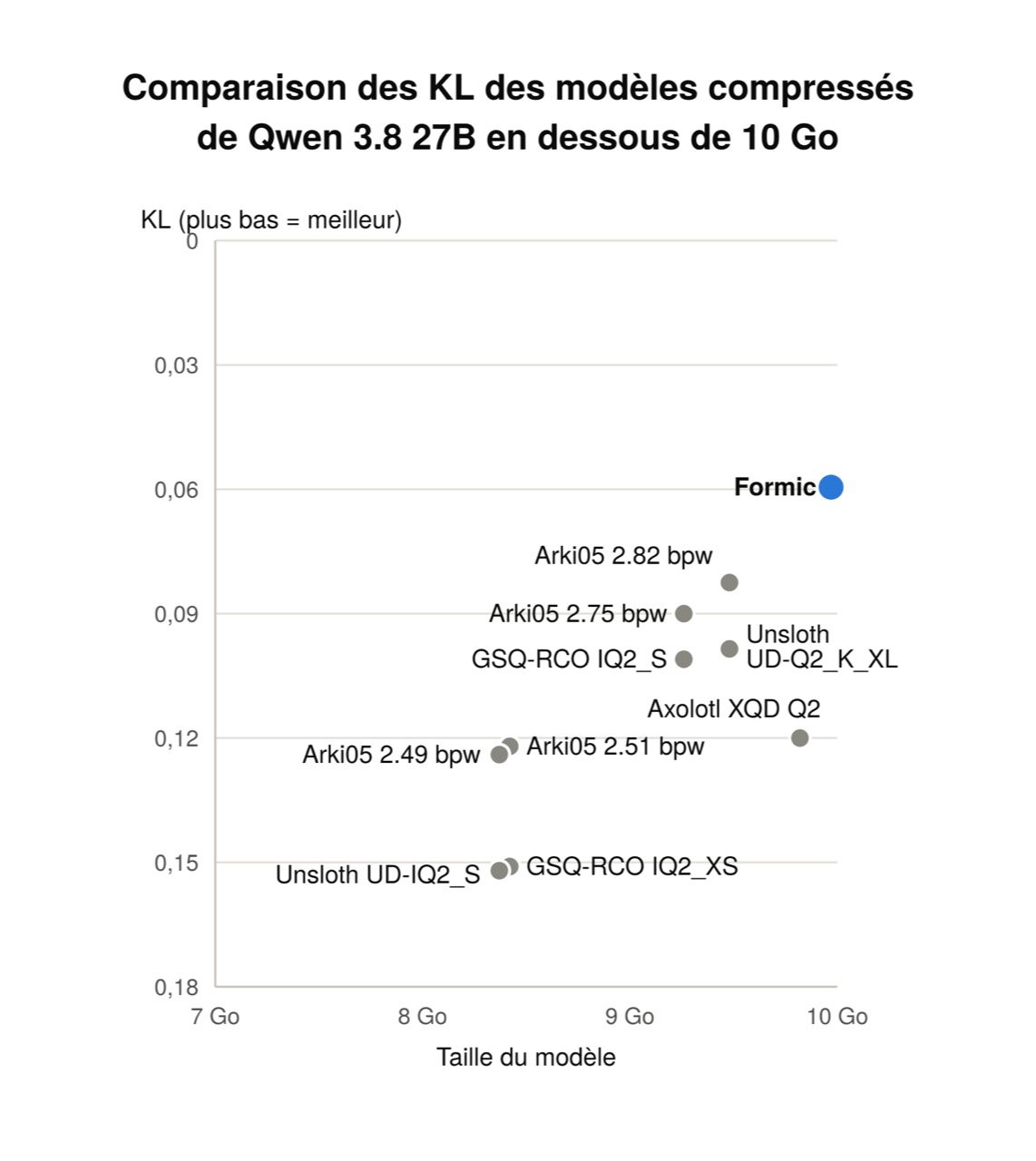
The lowest KL among quantized versions under 10 GB.

KL divergence measures the gap between the probability distributions of the quantized model and the original. The lower the value, the better quantization preserves the model's behavior.

In our direct evaluation on the same windows, Formic V1's KL is about 31% lower than Arki05 2.82 bpw and 50% lower than Axolotl XQD Q2. Agreement with the reference model on the most likely token reaches 90.53%.

Quantized Qwen 3.8 27B · under 10 GBKL ↓ lower is better
{{r.rank}} {{r.name}} {{r.kl}}
Open the full comparison ↗
Layer 02Quantization

Lumen, our own quantization method.

Quantizing a model means reducing the space needed to represent its weights. The hard part is doing it while limiting the disturbances it introduces into the model's computations.

Lumen relies on the E8 lattice to represent weights in groups. A compensation mechanism accounts for the errors introduced along the way, to limit their effect on the model's outputs. The method progresses layer by layer, taking into account the behavior of the network already partially quantized.

Fig. 02 — Compensation, explained with an image
Allowed shades

Quantizing means keeping fewer shades to take up less space. An image shows it better than numbers: each pixel is a number, just like each weight of a model.

OriginalAll shades

Heavy to store.

Rounded without compensation{{lumenBits}}

Each pixel is rounded on its own. Small errors pile up: gradients turn into flat patches and details vanish.

Rounded with compensation · Lumen{{lumenBits}}

Each pixel’s error is passed on to its neighbours. Same number of shades, same size, but the image stays faithful.

Lumen applies this principle to the 27 billion weights of Formic V1: each weight is rounded, and its error is compensated by the following weights. The model fits in 9.97 GB and stays close to the original.

01

Represent weights in groups on the E8 lattice.

02

Compensate errors as quantization progresses.

03

Calibrate on varied data, close to how the model is used.

Calibration set
{{c}}

Formic V1 keeps the base model's architecture. Its results come from our quantization and inference optimization work, without distillation or additional post-training.

−11.6% Enriching the calibration reduced KL by 11.6% on the public protocol, at equal size.
Layer 03Runtime · C++ & CUDA

An inference engine designed with the model.

Compression only matters if the result runs well. To turn it into usable performance, we built our own inference engine in C++ and CUDA. Quantization and engine are developed together, which lets us tune the trade-off between memory, speed and fidelity, notably on 12 and 24 GB cards.

CPU NVIDIA

Adapt execution

The engine runs Formic on CPU and NVIDIA GPUs. It adapts the representation of the weights to the available resources and optimizes the network's operations to reduce generation time.

RTX 3090 · 24 GB64.39 tok/s
RTX 3080 Ti · 12 GB27 tok/s
Tokens since you arrived 3090 0 · 3080 Ti 0

Ant speed and counters are simulated at the measured throughput.

MTP

Speed up generation

The engine uses MTP to propose several tokens in advance. The model checks these proposals before accepting them: when several are validated, generation moves forward faster.

{{t.t}}
{{mtpInfo}} proposed accepted model
Layer 04From model to product

One colony, one chain.

Owning the full technical chain opens a concrete possibility for Ulycorp: adapting open models, optimizing them, deploying them and integrating them into our products, including Yoovi and Uly.

{{c.n}} · {{c.k}}

{{c.t}}

{{c.b}}

Layer 05Ecosystem

Uly×Formic

Uly is Ulycorp's agent harness. It is built for code and software development, and for any other kind of work: it adapts to every field. Uly provides the workspace and the organization of agents. Formic provides a model foundation that we can optimize and evolve for these uses.

Uly Code · software development Uly Work · every other kind of work
Orchestrator
{{a.name}}
Formic · optimized modelsUly · environment & organization ↑

From software development to general work.

Long agentic tasks and software development are central to our vision. They require holding on to a goal, understanding an environment, using tools and checking results over time.

We want to extend these capabilities to projects in every field: research, analysis, document preparation and organizing work.

About Uly ↗
Layer 06Under construction

Formic V2, a new base for what comes next.

The announcement of Qwen 4 27B led us to postpone Formic's release, to go further on our quantization algorithm and our inference engine.

Formic V1 gives us a working, measured recipe that we plan to adapt to this new base. Its effectiveness on Qwen 4 27B will have to be confirmed by the corresponding evaluations.

Chamber built

Formic V1

Qwen 3.8 27B · Lumen quantization · own inference engine.

Ready

Formic V2

Will be built on Qwen 4 27B. It will first be released without distillation or additional post-training, as a version based on our quantization and inference optimization work, and will be the development base for our next versions.

Later versions will progressively enrich this foundation, with dedicated training and several technologies from our research. The ambition: models able to work on a project for a long time, adapt to their environment and cooperate effectively.

Personalization, memory and cooperation.

Research work

These integrations make up the roadmap for the following versions. They will be developed and evaluated progressively, along with the planned distillation and post-training.

BedrockWhy it matters

Making sovereignty accessible.

Our goal is to build a sovereign AI offering that gives users more control over their deployment, their data and their costs. That sovereignty has to be accessible in practice: a simple installation, clear usage and a cost within reach of SMEs and individuals.

Formic V1 is a first concrete base for this project. Next comes bringing this efficiency together with the personalization, memory and cooperation needed for an AI that can support everyone's work over time.

More accessible sovereignty, through simple installation at lower cost.

Contact Ulycorp Read: Formic-Link ↗